


The global semiconductor supply chain is to see a transformation, spearheaded by the US government’s move to tackle chip shortages and safeguard its economy, which would benefit semiconductor foundries, including Taiwan Semiconductor Manufacturing Co (TSMC, 台積電), Fitch Ratings said yesterday.
The US Innovation and Competition Act (USICA), endorsed by the White House and passed by the Senate, would allocate large-scale funding for domestic chip production to alleviate supply chain crunches and ensure dependable semiconductor sourcing. The bill is awaiting passage by the US House of Representatives.
Leading chip makers such as TSMC, South Korea’s Samsung Electronics Co and the US’ Intel Corp would be the biggest beneficiaries due to their specialty in producing leading-edge nodes, Fitch said.
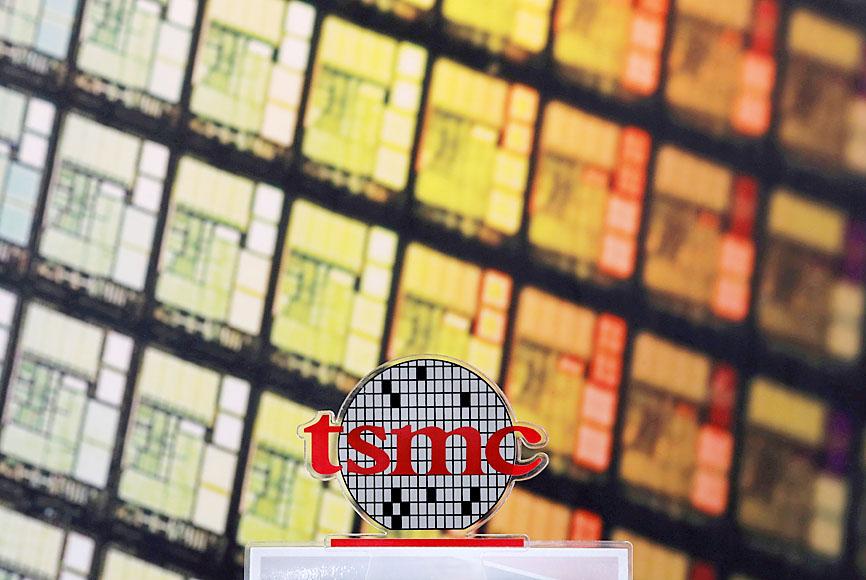
Photo: Tyrone Siu, Reuters
The windfall would extend to capital equipment suppliers such as KLA Corp and ASML Holding NV for supplying the tools used in the production of advanced chips, Fitch said.
The bill is intended to boost global competitiveness in industries deemed critical, with US$250 billion of government investment, it said, adding that about US$52 billion is to fund semiconductor research, design and manufacturing initiatives.
The US Department of Commerce expects the policy to unlock private investment, resulting in US$150 billion or more in funding for seven to 10 new US-based factories.
Several firms have announced expansion plans in the US. TSMC has announced a US$12 billion plan to build a 5-nanometer plant in Arizona, with media reports saying it is mulling up to five additional plants. Intel expects to invest US$20 billion in two new manufacturing facilities in the same state and Samsung intends to spend US$17 billion on a new 5-nanometer plant in Austin, Texas.
US policymakers view the semiconductor industry as strategically important because it supplies the fundamental enabling technologies for advanced defense, communications, big data and artificial intelligence among other industries, Fitch said.
The ongoing semiconductor shortage, driven by a confluence of factors, including inadequate capacity and stronger-than-expected demand, has highlighted supply chain vulnerability, it said.
The predicament also underscores the need to secure a dependable source of semiconductor components as the US’ share of semiconductor production has declined to about 12 percent from 37 percent in 1990, it said.
The global chip shortage has enhanced the bargaining position of foundries, Fitch said, adding that TSMC recently announced price increases of up to 20 percent.
Some chip consumers are making upfront payments to secure supply, Fitch said.
Electric vehicle maker Tesla Inc is expected to pay in advance to secure capacity, while Apple Inc has reserved TSMC’s initial capacity of 4-nanometer for its latest generation MacBook, it said.
TSMC supplies 50 to 55 percent of global semiconductor output and is the only foundry capable of turning out 7-nanometer and even more advanced chips, which enable everything from the latest smartphone models to graphics processing units used in data centers and artificial-intelligence applications.
TSMC’s operations are primarily centered in Taiwan, resulting in heightened geographic concentration risks, as earthquakes, droughts and blackouts have challenged manufacturing, Fitch said.
Ongoing droughts have the potential to affect TSMC’s production volume, as it uses 63,000 tonnes of water per day, it said, adding that Taiwan is also dealing with a COVID-19 outbreak.

Taichung reported the steepest fall in completed home prices among the six special municipalities in the first quarter of this year, data compiled by Taiwan Realty Co (台灣房屋) showed yesterday. From January through last month, the average transaction price for completed homes in Taichung fell 8 percent from a year earlier to NT$299,000 (US$9,483) per ping (3.3m²), said Taiwan Realty, which compiled the data based on the government’s price registration platform. The decline could be attributed to many home buyers choosing relatively affordable used homes to live in themselves, instead of newly built homes in the city’s prime property market, Taiwan Realty
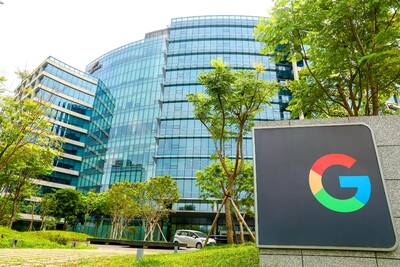
The government yesterday approved applications by Alphabet Inc’s Google to invest NT$27.08 billion (US$859.98 million) in Taiwan, the Ministry of Economic Affairs said in a statement. The Department of Investment Review approved two investments proposed by Google, with much of the funds to be used for data processing and electronic information supply services, as well as inventory procurement businesses in the semiconductor field, the ministry said. It marks the second consecutive year that Google has applied to increase its investment in Taiwan. Google plans to infuse NT$25.34 billion into Charter Investments Ltd (特許投資顧問) through its Singapore-based subsidiary Fructan Holdings Singapore Pte Ltd, and

JET JUICE: The war on Iran’s secondary effects have seen fuel prices skyrocket, knocking flight schedules down to earth in return as airlines struggle with costs Airline passengers should brace for more irritation in the next few months as carriers worldwide cancel flights and ground planes to cope with stratospheric increases in jet-fuel prices. Dutch flag carrier KLM is the latest company to cut its schedule, saying on Thursday that it would scrap 80 return flights at Amsterdam’s Schiphol Airport in the coming month. That puts it in the same league as United Airlines Holdings Inc, Deutsche Lufthansa AG and Cathay Pacific Airways Ltd, which have all pruned itineraries to mitigate costs. Global capacity for next month has been reduced by about 3 percentage points, with all
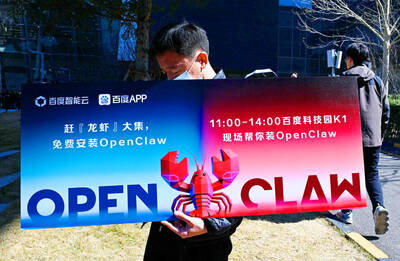
FORESEEABLE CONSEQUENCES: New technology always comes with new innovations by the iniquitous in exploiting users for financial gain or more nefarious ends Artificial intelligence (AI) “agents” say they can save users time and energy by automating tasks, but the growing power of systems such as OpenClaw is putting cybersecurity experts on edge. Powered by a wave of hype, OpenClaw today says it has more than three million users worldwide. The system allows users to create so-called agents, tools based on a large language model (LLM) such as OpenAI’s ChatGPT or Anthropic PBC’s Claude, that can carry out online tasks. “We’ve moved from an AI you could talk with via a chatbot to an agentic AI, which can take action... the threat and the risks are


 RSS
RSS